What it is
The P5 structure, taken out of the project
11
categories
51
elements
5
lenses
255
evaluation methods
Free
always
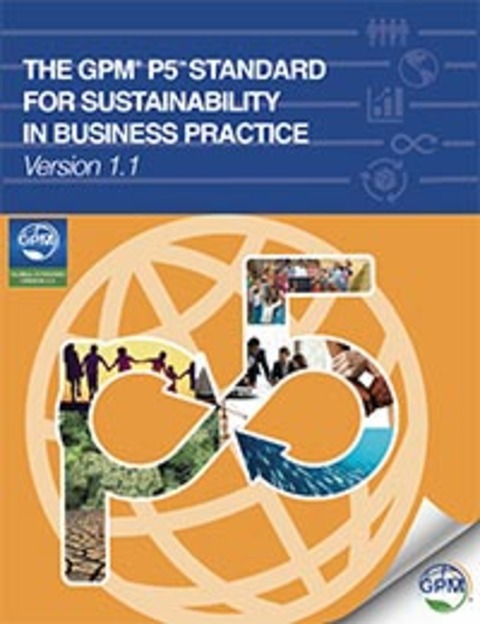
Organizations began using GPM's P5 Standard for Sustainability in Project Management for work that had nothing to do with projects: supplier reviews, facility audits, product decisions, annual planning. Business leaders told GPM that the sustainability standards available to them were confusing and built for compliance rather than for running a business. The P5 Standard for Sustainability in Business Practice answers that: the same impact structure, written for operations.
It keeps the triple bottom line of People, Planet and Prosperity and adds the two perspectives that make P5 usable, Product and Process: what the organization puts into the world and how it produces it. Eleven categories hold 51 elements, and five lenses give 255 distinct ways to assess an impact, so that a small business and a multinational can both find the level of detail they need.
Structure
Three bottom lines, eleven categories, two perspectives
| Category group | Categories | What they cover |
|---|---|---|
| People (four categories) | Labor practices and decent work; society and customers; human rights; ethical behaviour | How the organization treats the people who work for it, buy from it and live where it operates. |
| Planet (four categories) | Transport; energy; land, air and water; consumption | Emissions, resource use, waste, biodiversity and the physical footprint of operations and products. |
| Prosperity (three categories) | Feasibility and business case; adaptive governance; market and economic stimulation | Whether the business creates lasting value, governs itself adaptively and contributes to the economies it works in. |
Each element is examined from the Product perspective, across the life of what the organization sells or delivers, and from the Process perspective, across how it is produced, sourced and governed. The five lenses (lifespan and servicing for Product; efficiency, effectiveness and fairness for Process) turn a category into questions a manager can answer with evidence.
The standard is mapped to the United Nations Sustainable Development Goals, so that an organization's business activities can be tied to the global goals they advance, and it aligns with GRI disclosure so that what is assessed can be reported without reconstruction.
In practice
Assess, intervene, report
Step 1
Assess with the P5 Impact Assessment
Score each element on the 1 to 5 scale against the organization's baseline, from both perspectives, recording the indicator and source for every score. The No Masking Rule applies: a strong score in one area cannot hide harm in another.
Step 2
Plan interventions
The Sustainability Intervention Plan turns material findings into commitments with owners, targets, budgets and dates, and records the trade-offs made in reaching them.
Step 3
Report and repeat
Because every element maps to GRI and the SDGs, the assessment feeds the organization's disclosures directly. Reassess on a fixed cycle; the change between assessments is the performance record.
For leaders
One language across the business
Organizations that run projects on the P5 Standard and operations on the Business Practice standard produce impact data in one structure, from the portfolio to the shop floor.
Who it is for
Leaders, operations and sustainability functions
Organizational leaders who need to align the business with global sustainability goals and show evidence that they have. Operations and functional managers who are asked to integrate sustainability into procurement, facilities, product and people decisions and need a method rather than a slogan. Sustainability professionals who own ESG reporting and need the operational level to produce the data the report requires.
The standard is also the reference for GPM's PSM3 assessment of organizational sustainability maturity and for the P5 tailoring GPM does with organizations that want the standard fitted to their governance and reporting frameworks.
Getting started
Download, assess one business unit, then scale
Download the standard, the assessment workbook and the intervention plan. All three are free: the standard (a short form, then the PDF), the P5 Impact Analysis workbook, version 7.0 and the Sustainability Intervention Plan template, version 3.0.
Assess one business unit or product line. The first assessment usually takes a small team a few working days and produces the organization's first evidence-based impact register.
Build the competence and the governance. The Sustainability Competence Standard defines what the people doing this work must be able to do; Sustainability in Practice defines the professional obligations that go with it.
Questions
Frequently asked
What is the P5 Standard for Sustainability in Business Practice?
GPM's standard for organizations, published in 2024, that takes the P5 impact structure out of the project and applies it to how a business runs. Eleven categories, 51 elements and five lenses give a business one way to identify, score and manage its impacts on People, Planet and Prosperity.
How is it different from the P5 Standard for projects?
The project standard measures what a project delivers and how. The business practice standard measures what an organization does day to day: its operations, products, supply chain, workforce, governance and market behaviour. The structure is the same so that project data and business data speak one language.
Is it published with PMI?
No. This is a GPM publication. The project management standards and guides are PMI-GPM publications; the Business Practice standard and the Sustainability in Practice guide are GPM's own.
What tools come with it?
The P5 Impact Assessment workbook for business practice and the Sustainability Intervention Plan template, both free with the standard.
How does it relate to GRI and ESG reporting?
Every element is written so that its evidence can be carried into GRI, ISSB and SDG disclosure. The standard gives an organization a structured way to document and communicate sustainability performance, which is what most ESG reporting asks for and rarely gets from the operational level.
How much does it cost?
Nothing. The standard, the assessment workbook and the intervention plan template are free downloads with no membership.
Author
Dr. Joel Carboni is the founder and president of GPM and the architect of the standards, methods, and certifications behind Sustainable Project Management®, delivered through the PMI-GPM joint venture. He created the P5 Standard, the Sustainability Competence Standard, the Sustainable Project Management® Practice Guide, the Project Sustainability Reporting Guide and the PMI GPM Guide to Responsible Project Sponsorship. For over 30 years, his work has moved the profession in a different direction. A Forbes Business Council member and Global Reporting Initiative (GRI) contributor, he was shortlisted for Thinkers50's inaugural regenerative business award in 2025 for his book Becoming Regenerative.
Published 5 September 2026. Corrections through the contact page.
GPM®, Green Project Management® and Sustainable Project Management® are registered trademarks of GPM Ltd. PRiSM™, P5™, CSPP™, CSPMs™, CSPMx™, CSP™, CSF™, GPM360°™ and PSM3™ are trademarks of GPM Global and, where applicable, PMI-GPM. PMI and PMBOK are registered marks of the Project Management Institute.
Also on this site
The P5 Standard for Sustainability in Project Management: the project version. Sustainability in Practice: the professional standard built on this one. PSM3: how mature the organization is.