
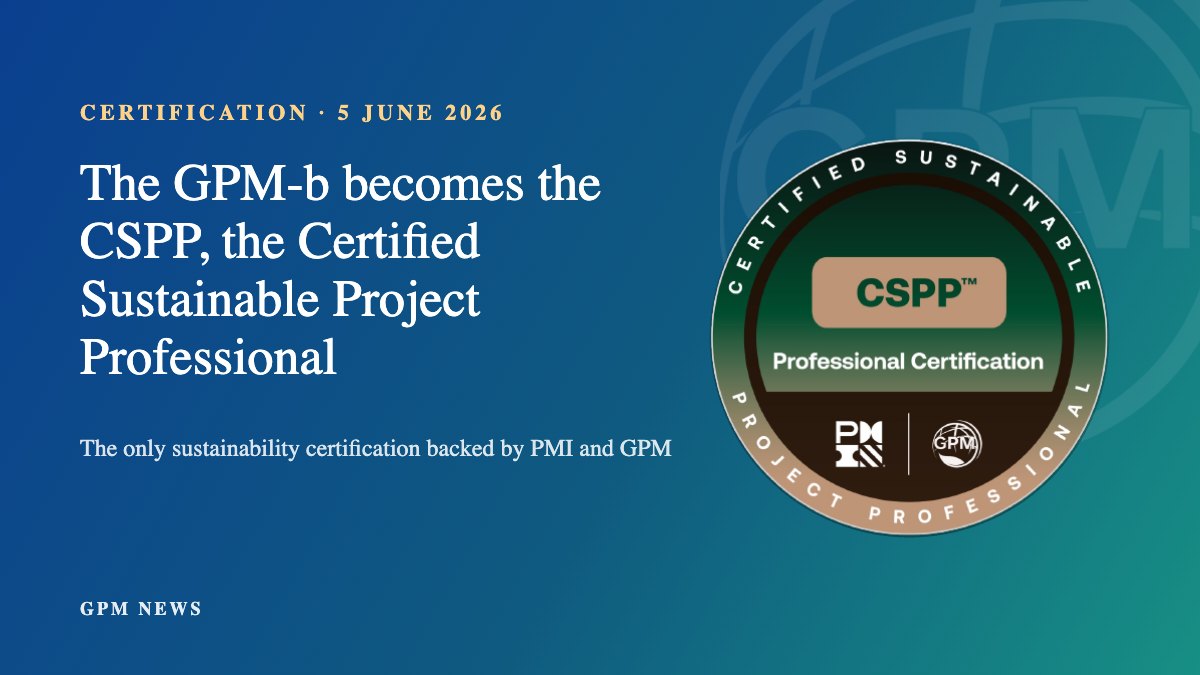
On 5 June 2026, World Environment Day, the Green Project Manager (GPM-b™) became the Certified Sustainable Project Professional (CSPP™), delivered through the PMI and GPM joint venture.
The GPM-b was established in 2013 as the first sustainability certification for project professionals. Thousands of practitioners earned it and applied its principles across industries, geographies and project types. It created a foundation where none existed and moved sustainability from concept into execution inside the project lifecycle.
The CSPP reflects how the profession has matured. Sustainability now sits inside governance, planning, decision-making and delivery, as a knowledge area that intersects with cost, risk, schedule, quality and value realization. The scope spans labor and working conditions, community impacts, emissions, resource use, compliance, ethics and adaptive governance. The certification is built for practitioners who deliver outcomes under real constraints, and it focuses on the tools, methods and decision frameworks that apply within active projects and fit existing delivery models without a parallel system.
The CSPP follows the PMI Gold Standard certification format and is the only sustainability certification backed by two global leaders: PMI, the world’s largest project management body, and GPM, the publisher of the P5 Standard. It is built on P5 Version 4 and launches with a new e-learning program.
What this means for GPM-b holders
Current GPM-b holders may opt in to upgrade to the CSPP at no cost, with no exam and no additional training. Holders may also choose to keep the GPM-b designation through its current validity period. The work behind either certification rests on the same foundation.
Projects are the point of execution for strategy, policy and investment. Embedding sustainability at that level is how organizations move from stated intent to measurable outcomes. The CSPP is how the profession makes that commitment operational.